

Foreword

This report speaks to the lived experience of so many disabled customers. I can see and hear my voice around the unnecessary barriers put in place by businesses who don't understand the power of the Purple Pound and the straightforward solutions that can be put in place to unlock the disability market.
It is exactly the reason I set up Purple Tuesday. To support businesses to better understand both digital and physical accessibility and provide me and others to have a good customer experience. The key to brand loyalty.
The report sets out the issues and clear recommendations for businesses wanting to go on their own inclusive journey. As a disabled customer, I am asking you to read and adopt the recommendations. It makes commercial and social common sense.
Mike Adams, founder of Purple Tuesday
Executive summary
The compelling argument
In the UK, disabled people and their households have a combined annual spending power of £446 billion (2025).
43% of disabled consumers have abandoned a purchase due to accessibility barriers.
70% of people say they would not return after a bad customer service experience.

Shopping is an important part of how most of us navigate daily life. In the UK, an estimated 16.8 million people (1 in 4) have a disability, and for many of these individuals, the journey through both physical and digital retail remains filled with barriers.
The Hidden Journey report from Nexer Digital highlights these obstacles, drawing on original survey data, accessibility audits, in-depth interviews, and the latest research to reveal the true cost of inaccessibility, and calling for an urgent need for change in the sector.
A 2023 government survey with 1,418 respondents showed the sector in which disabled customers experience the most barriers is retail.
Have you experienced barriers or accessibility issues when trying to buy or use products or services from the following sectors in the last twelve months?
Figure 1. UK Government, Accessibility of Private Sector Products and Services (2023)
Our own research found that accessibility problems are predictable, avoidable, and commercially significant.
Customers don't report problems — they often leave
- 36% of customers agreed they abandoned their shop or left early quite frequently, and 7% very frequently.
- They switch to a competitor, with 48% finding an alternative provider to purchase the item more easily.
Customers also take on additional labour to complete basic tasks.
- Applying workarounds: 88% agree they have to adopt workarounds or compromises due to inaccessibility
- Asking for help: 43% ask someone they know for help at the checkout or the completing transaction stage
Poor accessibility erodes trust and reputation.
- 87% agree or strongly agree that they avoid, or would avoid, a retailer because of previous accessibility issues.
- 74% agree or strongly agree that they tell, or would tell, others to avoid a retailer because of accessibility issues.
Customers are more loyal to brands that meet their access needs
- 98% say they are more likely to buy again.
- 81% say they would recommend to others.
The Hidden Journey calls on retailers, policymakers, and partners to move beyond compliance and see accessibility as both a strategic advantage and moral imperative.
When accessibility is embedded into design, development, staff training and customer service, everyone benefits. Retailers see reduced cart abandonment, increased loyalty, positive referrals and access to a significantly wider customer base.
"I get really stressed with online shopping. I worry that I will click the wrong thing, accidentally go on a site that is a scam or copycat, put in the wrong details etc. It also takes me an exceedingly long time to do, as I need to check and re-check any and all details." Interview Participant
Why accessibility in retail matters
What if the biggest barriers your customers face are the ones you never encounter yourself? Retail experiences are about more than just the transactions. They're about independence, dignity, and participation in society. Yet, for 1 in 4 people in the UK, shopping is often a journey filled with obstacles, both visible and hidden. The Hidden Journey explores these challenges, revealing what can be often unseen by non-disabled people and overlooked by businesses.
Legal, ethical and commercial responsibility
Accessibility is not just good practice, it's the law. The European Accessibility Act (EAA) sets clear requirements for businesses operating in the European Union to ensure their products and services — including retail environments — offer equal access for people with disabilities. For retailers, this means designing experiences that meet these standards is a legal obligation, which impacts digital platforms, payment systems, physical spaces and after sales.
Under the Equality Act of 2010, service providers must practise the following four steps to ensure they are making reasonable adjustments for disabled people, as well as for other protected characteristics:
- Provide a service that meets all customer needs
- Plan ahead for your customer needs
- Communicate with your customers
- Provide staff training
But beyond being a legal requirement, accessibility is an ethical imperative and a potential driver of innovation, loyalty, and growth. Our research brings together the voices of disabled consumers, sector data, and actionable insights to help retailers create a fairer, more inclusive experience for everyone.
"I find this easier than shopping in store and quicker to find things. I use the search facility. I stick to the same websites though, ones that I find easier to use and familiar with them." Survey Participant
Our methodology
We combined national evidence with new research to understand how accessibility issues show up in actual retail journeys. Large datasets tell us how common barriers are. Our survey and interviews helped us understand what those barriers look like in practice and their effect on people and their behaviour as consumers.
- Survey — Conducted with disabled consumers across the UK, focusing on both online and in-store experiences.
- User interviews — In-depth interviews mapping real retail journeys, highlighting barriers and workarounds.
- Accessibility audits — Reviews of popular retail, finance, and travel websites.
- Secondary research — Analysis of leading reports and datasets, including Gov.UK, Business Disability Forum, Scope, and Transport for All.
Participants varied in age, disability or condition, access needs, digital confidence, and shopping habits, allowing us to reflect a range of real-world experiences.
The national data shows the scale of the problem. The survey shows where journeys break. The interviews show why they break and what customers do next. Together, they provide a clear view of accessibility in retail and the practical changes that would make the biggest difference.
The combined annual spending power of disabled people and their households in the UK (2025) — the Purple Pound
87% of our survey respondents were unable to complete the full retail journey independently
43% of disabled consumers have abandoned a purchase due to accessibility barriers
70% of people say they would not return to a retailer after a bad customer service experience
88% agree they have to adopt workarounds or compromises due to inaccessibility
98% of survey participants say they are more likely to buy again from retailers that meet their access needs
The scale of the problem
Across all sources, the message is consistent: accessibility issues are widespread, predictable, and significantly more common in retail than most businesses realise. We focused on three specific sectors — retail, finance and travel — because they combine two key things: they are among the sectors where disabled people report the most barriers, and they represent essential, everyday activities: buying goods, managing money, and moving around.
We wanted to dig deeper
National data clearly shows how common accessibility barriers are and which sectors are most affected. But it does not explain what retailers, banks, or travel providers most need to understand to improve their services. We wanted to explore some of these questions:
- Where exactly do these barriers appear within the customer journey? Are issues happening at browsing, selection, checkout, or after purchase?
- What happens when someone hits a barrier? Do they try again, give up, switch to a competitor, or ask someone else for help?
- How much extra effort are customers taking on to complete basic tasks? And how often does that effort lead to abandonment rather than completion?
- Which barriers matter most to customers? Are small design issues enough to break trust, or is it only major failures?
We explored what retailers might change that would make the biggest difference to people's experiences and their behaviour — not just what would make them 'compliant'. As a provider of accessibility services, with many of our Nexer Digital team having personal experience of barriers, we also did an inclusive design review of some leading retail websites, to understand where things work well and where there might be room for improvement. We mapped this visually, through screenshots, survey data and interview quotes.
Section 1
Mapping The Hidden Journey
Where barriers appear in the journey
Across all journeys, a striking 87% of disabled consumers told us they couldn't complete the full retail experience independently. For retailers, this represents a direct impact on conversion, loyalty, and brand reputation.
To pinpoint the areas with the biggest potential for reducing barriers to access, and gaining value, we mapped the customer journey across four critical stages:
Browsing → Selecting → Checkout/Confirmation → Post-purchase.
At each stage, we highlight where customers encounter barriers, and how they respond to these blockers.
- Browsing — Finding and exploring products or services ("In the past 12 months, were you usually able to browse or look through products or services online by yourself without any help?")
- Selecting — Choosing the item or service ("After browsing, were you able to select the item or service you were looking for without any help?")
- Checkout — Completing the transaction or application ("Were you usually able to complete the transaction or process without extra help?")
- Post-purchase — Accessing support, tracking, or making changes after buying ("In the past 12 months, were you usually able to manage post-purchase tasks without any help?")
We focused on three specific sectors because they combine two key things: they are among the sectors where disabled people report the most barriers, and they represent essential, everyday activities — buying goods, managing money, and moving around.
Retail (in-store and online): 65% faced barriers in the past 12 months; 88% applied workarounds. Retail is the sector where disabled people report the highest frequency of accessibility barriers.
Financial Services (banking and payments): 33% faced barriers in the past 12 months; 81% applied workarounds. Although fewer people report barriers in finance, the impact has the potential to be more serious. Barriers here can prevent people from completing essential tasks such as managing accounts or applying for products.
Travel (booking and transport): 56% of respondents report being unhappy or extremely unhappy making journeys. Respondents reported making on average just 5.84 journeys per week — roughly a third of the national average of 17 trips per week.
"I prefer to do most shopping online as I can use a voice on my iPad, some websites are better than others and it can be frustrating. I always do the grocery shopping online as going into a store and finding all the products I need is not possible on my own. When it comes to clothing, I have a few stores in my area where the assistants are so helpful and nothing is too much trouble whether it be helping with sizes or explaining what the item looks like. You would think all stores are supportive of this as they get the sales but that is not the case!" Interview Participant
Section 2
Survey findings
Who can and cannot complete each step independently
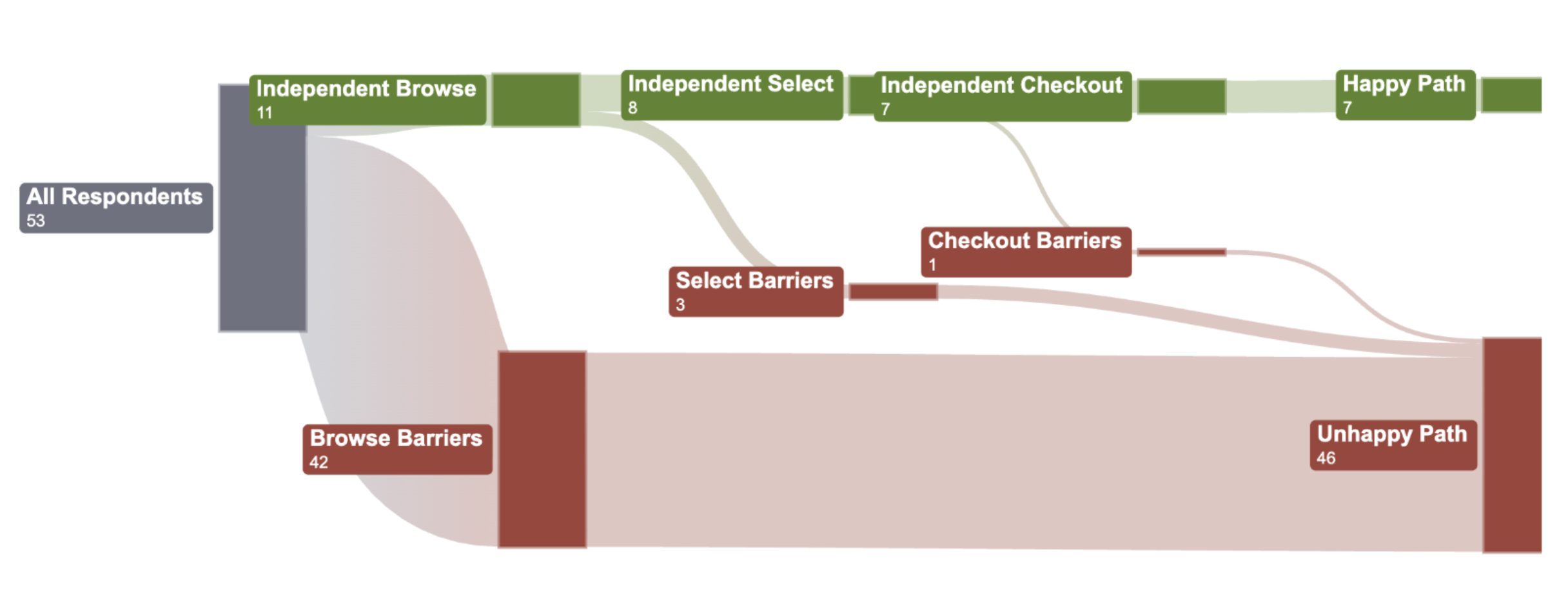
87% of our survey respondents were unable to complete the full journey independently.

Figure 2. Journey completion and abandonment [7]
It's worth noting that a completed transaction does not always mean a successful experience. Many people can finish a purchase only by taking on extra effort, relying on workarounds, or asking someone else for help. To reflect this, we defined the "happy path" as being able to move through each stage of the journey — browsing, selecting, checkout, and post-purchase — independently and without difficulty.
This reframes success around three things that matter to customers:
- Autonomy — being able to complete tasks without relying on others
- Ease — being able to progress without unnecessary effort or friction
- Dignity — being able to shop without frustration, exposure, or loss of privacy
What people do when faced with barriers
Our research highlights that very few people report accessibility problems. Across all stages, only a small number contacted customer support or submitted feedback. This remains true even when issues prevented people from completing tasks independently.
The most effort is absorbed by the customer, and this could mean that brands are unaware of those they are excluding — because their data is erased from any segmentation analysis. Many participants tried again later, applied workarounds, or asked someone else for help. These behaviours increase effort, reduce independence, and often remain invisible to retailers, particularly when a transaction still goes through.
Early barriers lead to switching; later barriers lead to abandonment. Switching to an alternative site was most common during browsing, while giving up entirely was more common during selection and checkout.
"So I would be gone at this point because all I want to do here is open a bank account, I can't find the link or the button or something, so I'd be gone from this one." Interview Participant
During checkout and post-purchase, reliance on others increases. This often involves sharing personal or financial information and losing control over the process — an outcome participants consistently described as undesirable.
"I don't want to ask somebody for help, I don't want people to know my information, how much money I've got in the bank... Would you leave your bank statement lying on your dining table so that anybody that comes into your house can read it? Well, don't expect me to. It's my money, it's my journey. And it's my information to keep discreetly to myself. And I can't do it if I need to ask for help." Interview Participant
Some prefer online, others opt for in-store
The aim should be to offer an inclusive experience across all channels, but there are several factors influencing the choices people feel they have. These include customer service, staff training, transport, location, items sought, confidence, access needs and familiarity, all of which can lead to mixed outcomes for disabled shoppers.
"In shops, I receive assistance or take a friend. Online, I stress." Survey Participant
Findings from our accessibility audit
Accessibility audits and usability reviews reinforce the survey results, revealing persistent and often overlooked issues at every stage of the customer journey.
Missing or meaningless alt text for images — Many product and navigation images lack descriptive alternative text, making it difficult or impossible for screen reader users to understand what's being shown or to complete key tasks independently.
Keyboard traps and inaccessible navigation — Interactive elements such as cookie banners, pop-ups, and navigation menus frequently cannot be accessed or dismissed using only a keyboard. This leaves keyboard and assistive technology users unable to progress or even complete purchases.
Poor colour contrast for text and focus indicators — Text and interactive elements often fail to meet minimum contrast standards, especially on moving carousels or coloured backgrounds. This makes reading and navigation challenging for users with low vision or colour blindness and can cause users to lose track of where they are on a page.

Skipped, empty, or repetitive headings — Inconsistent heading structures such as missing heading levels, empty headings, or repeated headings confuse screen reader users and make it harder to navigate or understand page content.
Inaccessible forms and generic link text — Forms often lack clear labels or instructions, and links are frequently labelled with generic text like "click here" or "more," providing no context for users relying on assistive technology.
These barriers are often invisible to retailers but have a direct and significant impact on the autonomy, ease, and dignity of disabled customers. Most of the effort to overcome these obstacles is absorbed by the customer, not reported — resulting in "invisible friction" that quietly erodes conversion rates, customer loyalty, and brand reputation.
Section 3
Barriers to access
We brought together the highs and lows identified across our survey, interviews, accessibility reviews, and secondary research into a set of detailed journey maps. Each map shows how accessibility shapes the experience from start to finish. It highlights where things work well, where friction appears, and where people move away from the intended journey.
Rather than isolating individual issues, these maps show how barriers compound across a journey. Small problems early on can increase effort, reduce confidence, and change behaviour later — even if the task is eventually completed. And this has a cumulative effect on people's experiences and how they feel as consumers.
We focused on three everyday scenarios that reflect the sectors explored in this report: buying a shirt (retail), booking a flight (travel), and opening a bank account (financial services).

Browsing
Browsing is the point where customers are deciding whether it is worth continuing at all. When this stage is inaccessible, many people never reach product selection or checkout.
The most common barriers reported at this stage were a combination of design, content, and interaction issues that made browsing hard or impossible to complete independently.
If browsing for products or services was difficult or you couldn't do it: Where were the main barriers? (Select all that apply)
Figure 5. Spread of responses to the question about barriers (UK Government, Accessibility of Private Sector Products and Services, 2023)
What did people do when faced with barriers?
Asked someone they know for help
Many relied on family members or friends to help them navigate, interpret content, or find products.
Switched to a competitor
A significant number chose another retailer rather than continue struggling.
Tried again later on the same site
Some delayed the task, hoping the experience would be easier at another time or on another device.
Fixed the problem or applied a workaround themselves
This included adjusting settings, using assistive tools in unintended ways, or persisting through repeated attempts.
Contacted customer support
Only a small proportion sought help directly from the company.
Reported the issue
Very few used feedback forms or reporting mechanisms to flag the problem.
These responses show that most people do not raise accessibility issues with retailers. Instead, they either absorb the effort themselves, rely on others, or quietly take their business elsewhere.
Selecting
Barriers at the selection stage often appear after customers have already invested time in the journey. This helps explain why experiences at this point are more likely to result in reliance on others or abandonment.
What people did when selecting a product or service was difficult:
- Asked someone else for help
- Gave up entirely
- Tried again later on the same site
- Fixed the problem or applied a workaround themselves
- Tried an alternative site
- Switched to a competitor
- Contacted customer support
- Reported the issue
These findings suggest that barriers during selection can undermine confidence and momentum, even when customers are motivated to complete a purchase.
"I sort of know that the bag is somewhere in this area, but because I'm using this plug-in [inverted colours], I couldn't see it. I think it depends on which extension you use to invert colours, this extension was not allowing me to see anything in this area." Interview Participant
“These findings show how barriers compound across a journey. Small problems early on can increase effort, reduce confidence, and change behaviour later — even if the task is eventually completed. Most barriers are absorbed by the customer, not reported back to retailers. The result is invisible friction that quietly erodes conversion rates, loyalty, and brand reputation.”
Nexer Digital
Checkout
Checkout barriers occur at a critical point in the journey, where customers are attempting to complete a transaction.
What people did when completing the transaction was difficult or impossible:
- Asked someone else for help
- Gave up entirely
- Tried again later on the same site
- Tried another site or provider
- Fixed the problem or applied a workaround themselves
- Switched to a competitor
- Contacted customer support
- Reported the issue
At this stage, inaccessible experiences are strongly associated with abandonment or dependence on others, representing lost conversions and reduced independence for customers.
Post checkout
Post-checkout barriers affect customers after a transaction has been completed, including access to confirmation, account information, delivery updates, and support.
What people did when the post-purchase experience was difficult or inaccessible:
- Asked someone else for help
- Gave up entirely
- Contacted customer support
- Reported the issue
- Switched to a competitor
- Fixed the problem or applied a workaround themselves
- Tried an alternative site
- Tried again later on the same site
These responses indicate that accessibility issues do not end at the point of purchase. Post-checkout barriers can increase support demand, reduce trust, and negatively affect repeat custom and long-term loyalty.
Sector spotlight
Retail (stores and e-commerce) — The journey map reveals the most common friction points that cause customers to drop off or seek alternatives. Site navigation challenges and inaccessible product information drive early switching to more accessible competitors. Checkout barriers, from complex forms to inaccessible payment flows, lead to abandoned baskets. In-store, poor layout, unclear signage, and lack of staff support mean people either give up or must ask for help, undermining both independence and brand trust.
Financial services (banking and payments) — While fewer barriers are reported here (33%), the stakes are high. When authentication, account setup, or privacy controls are inaccessible, customers are forced to rely on others to help or abandon the process entirely. This erodes trust and can drive customers to more accessible competitors.
Travel (booking and transport) — Travel journeys are especially vulnerable to accessibility gaps. Over half (56%) of respondents said they were unhappy or extremely unhappy with their travel experiences, and they make far fewer trips than the national average. Early friction points, such as inaccessible booking tools, lead to switching, while later barriers — tickets, boarding, wayfinding — result in abandonment or dependence on staff.

Section 4
Comparison to Sweden
Nexer's accessibility team covers both the UK and Swedish markets, and we are always interested in cultural attitudes to inclusion. We completed some further work from our Stockholm team.
Alongside our UK research, Nexer Digital conducted an accessibility study with disabled and neurodivergent consumers in Sweden. We are including a high‑level comparison here because the findings reinforce the patterns identified in the UK.
Despite different national contexts, retail environments and service expectations, the Swedish study surfaced many of the same challenges across retail, travel and financial services. Participants described journeys impacted by confusing navigation, missing or unclear information, technical failures, and overstimulating interfaces, particularly pop‑ups, timeouts, and visual clutter.
“Every obstacle takes from my concentration budget. When it runs out, I can’t be present with my children, cook dinner, or drive safely.” Survey participant (Sweden)
As in the UK, accessibility barriers often required people to take on additional effort simply to progress. In Sweden, 35% of respondents who attempted a journey described having to use workarounds such as retrying later, troubleshooting problems themselves, switching websites, or contacting support.
These barriers frequently led to quiet disengagement rather than formal complaints. 28% of Swedish respondents described giving up entirely or switching to a competitor when barriers appeared, mirroring the patterns of abandonment and avoidance seen in the UK research.
“If something unexpected happens, I don’t always have the energy to troubleshoot. Sometimes it’s easier to just leave.” Survey participant (Sweden)
Importantly, Swedish participants also highlighted the cumulative impact of accessibility barriers on energy, stress, and independence — especially for people with neurodivergent, cognitive, or energy‑limiting conditions. These barriers were not experienced as minor inconveniences, but as constraints that affected daily life beyond the immediate task.
Taken together, the UK and Swedish studies demonstrate that accessibility barriers are predictable and systemic, and not market‑specific. They influence trust, behaviour and long‑term loyalty in similar ways across contexts, reinforcing the case for accessibility as a fundamental design and business priority.
35% of Swedish respondents described having to take workarounds or extra steps due to barriers.
28% said they gave up or switched to a competitor when barriers occurred.
73% said they’re more likely to buy again from companies that meet their access needs.

“The barriers disabled people face in everyday retail journeys are not inevitable, they are design choices. This report is a clear invitation to businesses to choose inclusion, not just because the law demands it, but because customers do.”
Tanzila Khan, Purple Tuesday Ambassador
Section 5
Making the business case for accessibility
Accessibility is not a limitation. It's a moral imperative and a strategic advantage. Our research shows that a completed transaction does not necessarily indicate a good or accessible experience. Many participants were only able to complete tasks by taking on additional effort or relying on support from others.
In our survey, 87% participants said they avoid, or would avoid, brands or retailers because of previous accessibility problems. A further 74% said they have told, or would tell, other people to avoid a brand due to poor accessibility. These findings indicate that inaccessible experiences influence not only individual purchasing decisions, but also wider patterns of avoidance and negative word of mouth.
For retailers, this represents both lost revenue and reputational risk that may not be immediately visible through conversion metrics alone, or indeed feedback mechanisms.
Good work is already happening in the sector
Across the retail sector, some organisations are already making meaningful progress, setting an example for accessibility in practice. The following examples showcase practical steps and proven approaches from leading brands in retail, financial services, and travel. Together, these examples demonstrate that accessibility is achievable at scale, and that improving accessibility can deliver clear commercial benefits, including increased reach, improved customer experience, and stronger long-term loyalty and brand reputation.
Retailers who act now to embed accessibility into every stage of the customer journey will not only comply with the law but will also unlock the full potential of the Purple Pound, build stronger brand loyalty, and future-proof their businesses against changing expectations and regulations.
“It was a pleasure to have the team from Nexer come to the AutoTrader Campus. We are on a journey here at AutoTrader to make all our products accessible to all, and we're determined that no one should be excluded from our services. This was a great opportunity to get some hands-on training and improve awareness of barriers that can arise from not having accessible products. The team were great in building empathy across our teams, showing great real-world examples of how we can apply good accessibility practices to our products. We are already looking forward to having more sessions and building on our relationship with Nexer.”
Stuart Hull, AutoTrader UK
Case studies

In 2024, M&S launched their line of ostomy underwear, in a UK high-street first. Inspired to act by an employee with personal experience of living with a stoma, the collection was co-designed with Colostomy UK and tested with members of the community. It's a powerful example of what's possible when people with lived experience are involved in the conception, design and testing of a product.

AutoTrader has taken significant steps to make the online car-buying journey more inclusive. In partnership with Nexer Digital, the company conducted an inclusive usability study on its Deal Builder service, engaging participants with visual, cognitive, and motor impairments. Testing was carried out on users' own devices with assistive technologies such as screen readers and voice control software. AutoTrader's commitment goes beyond compliance: inclusive design principles are now embedded across its digital offerings, and the company has invested in accessibility training for development, QA, and design teams, including hands-on sessions with assistive tech and empathy tools.

In 2024, Primark launched its first adaptive clothing range, co-designed with accessibility experts and tested by members of the community for comfort, practicality, and style. Featuring modifications such as magnetic zips, popper fastenings, inner waistband pulls, and discreet tube access, the range spans everyday essentials. To make shopping easier, Primark also introduced clear in-store navigation using NaviLens codes and distinctive lilac-and-grey product labels that highlight adaptive features and care instructions. This approach not only improves accessibility but also signals a commitment to diversity and inclusion in fashion.

IKEA has embedded accessibility into its digital strategy through automated accessibility scanning tools and inclusive user research. The company established a Digital Inclusive Design, Equity & Accessibility (IDEA) Centre of Expertise to guide teams globally. IKEA also piloted in-store navigation support for blind and low-vision customers, showing how accessibility can be integrated across physical and digital touchpoints.

Tesco has worked closely with the RNIB to identify opportunities to improve shopping experiences for blind and partially sighted customers. In store, they introduced a market-leading 'zoomed in' feature on self-service checkouts, helping customers with sight loss to check out independently. Tesco has also been commended for the accessibility of its website and app, and most recently launched a six-month trial of real-time support via the Be My Eyes app, allowing customers to connect with colleagues for live assistance while shopping.

Co-op has implemented a comprehensive Digital Accessibility Policy covering every stage of its design and delivery lifecycle. This includes research with participants who have access needs, design critiques, component testing, and annual audits. Co-op also maintains an open Experience Library to share best practices, ensuring accessibility is a continuous process rather than a one-off compliance exercise.
Section 6
Conclusions
All the research reinforces the same message: accessibility in retail is no longer a "nice to have" — it is a commercial, legal, and moral imperative. The barriers faced by disabled consumers are not only excluding millions from everyday experiences but are also costing the sector billions in lost revenue and missed opportunities.
Retailers who act now to embed accessibility into every stage of the customer journey will not only comply with the law but will also unlock the full potential of the Purple Pound, build stronger brand loyalty, and future-proof their businesses against changing expectations and regulations.
The Hidden Journey report demonstrates that practical solutions exist and that progress is already being made by forward-thinking organisations. Now is the time for the sector to move beyond compliance, embrace accessibility as a driver of innovation and growth, and ensure that every customer — regardless of ability — can shop, bank, and travel with confidence and independence.
Ready to take the next step? As your accessibility partner, Nexer Digital will help you to identify opportunities to improve accessibility in your digital products and services, raise awareness in your teams, drive inclusive culture, and support your organisation on its accessibility journey.

Get in touch
If you would like to work with our team on your project, email us at hello@nexerdigital.com or call us on +44 (0)1625 725446